Adding a new drug: single low-dose primaquine
OJ Watson
2026-11-11
Source:vignettes/NewDrugs.Rmd
NewDrugs.RmdOverview
magenta ships with AL, ASAQ and DHA-PPQ. Sooner or later
you will want something else: a new partner drug, a triple combination,
or a drug that works in a way the existing ones do not.
This vignette works through both cases. The first half shows how to
define a drug that fits the existing framework, which is mostly a matter
of supplying the right numbers to drug_create(). The second
half takes a drug that does not fit, single low-dose
primaquine (SLD-PQ), and uses it to map out exactly where the model
would have to be extended. That second half is intended as the starting
point for a project on modelling SLD-PQ, and it is deliberately explicit
about what the model cannot currently do.
Read the resistance vignette first; this one assumes you know what the barcode positions and the efficacy vector are.
Part 1: a drug that fits
Everything magenta knows about a drug is in the list
returned by drug_create(). To add a new one you need four
things:
- the probability that treatment succeeds for each genotype
- which barcode positions those genotypes correspond to
- which of those positions shorten post-treatment prophylaxis
- a curve describing how protection wanes, for sensitive and for resistant parasites
Suppose we have a new partner drug whose resistance is conferred by a
single new marker, which we will put at barcode position 6, and which is
also compromised by artemisinin resistance at position 4. That is two
resistance positions, so the efficacy vector has 2^2 = 4
entries, ordered with position 4 as the least significant bit:
new_drug <- magenta:::drug_create(
  prob_of_lpf = c(0.98,   # wild type at both
                  0.93,   # kelch13 580Y only
                  0.80,   # new partner drug marker only
                  0.55),  # both
  barcode_res_pos = c(4, 6),
  prophylactic_pos = 6,
  dur_P = 30,
  dur_SPC = 7,
  prophylactic_probability =
    1 - pgamma(seq(0, 60, 0.2), shape = 20, rate = 20 / 28),
  prophylactic_resistant_probability =
    1 - pgamma(seq(0, 60, 0.2), shape = 20, rate = 20 / 12)
)
str(new_drug)
## List of 9
##  $ lpf                   : num [1:4] 0.98 0.93 0.8 0.55
##  $ barcode_positions     : num [1:2] 4 6
##  $ prophylactic_positions: num 6
##  $ dur_P                 : num 30
##  $ dur_SPC               : num 7
##  $ hill_n                : num 5.71
##  $ hill_kA               : num 0.263
##  $ hill_res_n            : num 13.3
##  $ hill_res_kA           : num 0.564
The two protection curves say that the drug protects for about 28
days against a sensitive parasite and about 12 days against one carrying
the new marker. drug_create() fits the Hill parameters to
those curves for you.
The barcode now has to be long enough to contain position 6, so
num_loci goes up to 7 and the fitness cost table with
it:
dl_new <- drug_list_create(
  resistance_flag = TRUE,
  number_of_resistance_loci = 7,
  artemisinin_loci = 4,
  cost_of_resistance = rep(1, 7),
  drugs = list(new_drug),
  number_of_drugs = 1,
  partner_drug_ratios = 1
)

dl_new$resistance_loci
## [1] 4 6

out_new <- pipeline(
  EIR = 10, N = 2000, years = 12, ft = 0.4,
  num_loci = 7, plaf = rep(0.1, 7),
  update_length = 30, update_save = TRUE,
  human_update_save = TRUE, summary_saves_only = TRUE,
  genetics_df_without_summarising = TRUE,
  drug_list = dl_new, seed = 1L
)
## Seed set to 1
## magenta v1.3.8
## Starting Stochastic Simulation for 12 years
pos <- seq_len(length(out_new) - 1)
af <- do.call(rbind, lapply(out_new[pos], "[[", "af"))
colnames(af) <- c(paste("position", 0:5), "new marker (6)")
years <- seq_len(nrow(af)) / 12

matplot(years, af, type = "l", lty = 1, lwd = 2, col = seq_len(ncol(af)),
        ylim = c(0, 1), xlab = "Years", ylab = "Allele frequency",
        main = "A new partner drug")
legend("topleft", legend = colnames(af), col = seq_len(ncol(af)),
       lty = 1, lwd = 2, bty = "n", cex = 0.8)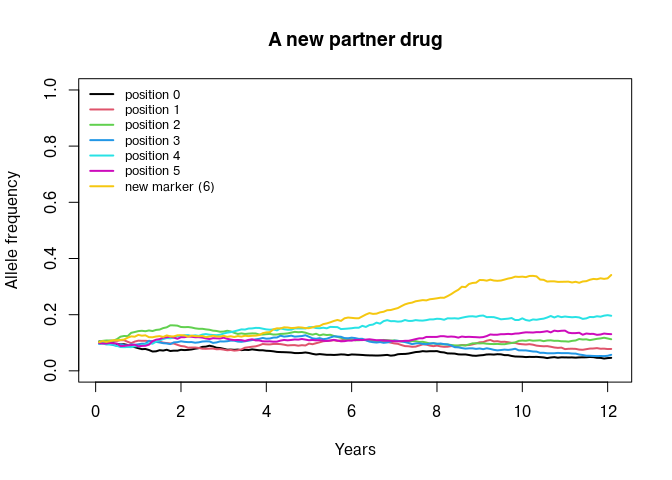
The new marker is strongly selected and kelch13 rises more slowly, which is what the efficacy table asks for. Defining a drug is really this easy, provided the drug acts by curing infections.
Part 2: a drug that does not fit
What single low-dose primaquine does
SLD-PQ is a single 0.25 mg/kg dose of primaquine given alongside an ACT. It is not there to cure the patient; the ACT does that. It is there to stop the patient infecting mosquitoes.
The World Health Organization recommended it in 2012, set out in the 2015 policy brief Single-dose primaquine as a gametocytocide in Plasmodium falciparum malaria (WHO/HTM/GMP/2015.1), for low-transmission settings and for areas threatened by artemisinin resistance, with no requirement for G6PD testing at that dose. Pregnant women are excluded; the infant age cut-off has been revised since the 2015 brief, so check the current guideline before choosing an age restriction to model.
The mechanism matters for how you would represent it:
- Artemisinins kill immature gametocytes, but mature stage V gametocytes already in circulation are largely unaffected. After an ACT, a patient can stay infectious to mosquitoes for days to weeks.
- Primaquine acts on those mature gametocytes, and sterilises them before it clears them. Infectivity collapses well before gametocyte density falls.
That last point is the crucial one. A model that represents SLD-PQ by accelerating gametocyte clearance will get the timing badly wrong.
Evidence for parameterisation
| Quantity | Value | Source |
|---|---|---|
| Reduction in mosquito infectivity, day 2 | 92.6% (95% CI 78.3-100) at 0.25 mg/kg | Dicko et al. 2016, Lancet Infect Dis |
| Reduction in mosquito infection rate, 48 h | 100% median with PQ vs 50.4% for DHA-PPQ alone | Stone et al. 2022, Lancet Microbe |
| Infectious feeds from day 5 onwards | 2 of 283 feeds infectious | Stepniewska et al. 2022, J Infect Dis |
| Mean time to gametocyte clearance | 7.7 days with PQ vs 19.7 days without | Goncalves et al. 2016, BMC Medicine |
| Gametocyte positivity, day 7 (odds ratio) | aOR 0.34 (0.22-0.52) | Yilma et al. 2025, Lancet Infect Dis |
| Residual infectivity after ACT alone | Partner drug dependent; large after DHA-PPQ, small after AL | Stepniewska et al. 2022, J Infect Dis |
References: Dicko et al. (2016) doi:10.1016/S1473-3099(15)00479-X; Goncalves et al. (2016) doi:10.1186/s12916-016-0581-y; Stone et al. (2022) doi:10.1016/S2666-5247(21)00192-0; Stepniewska et al. (2022) doi:10.1093/infdis/jiaa498; Yilma et al. (2025) doi:10.1016/S1473-3099(25)00078-7; Bradley et al. (2018) doi:10.7554/eLife.34463 for the relationship between gametocyte density and mosquito infection.
Two caveats are worth carrying into any analysis. First, no randomised trial has demonstrated a community-level transmission effect; the evidence is all individual-level infectivity. Second, the marginal benefit depends strongly on the partner drug, because after artemether-lumefantrine post-treatment infectivity is already close to zero, whereas after DHA-PPQ it is not.
Why the drug object cannot express it
Look again at what a drug is in magenta:
names(magenta:::drug_create_al())
## [1] "lpf"                    "barcode_positions"      "prophylactic_positions"
## [4] "dur_P"                  "dur_SPC"                "hill_n"
## [7] "hill_kA"                "hill_res_n"             "hill_res_kA"
Every one of these fields feeds into one of two things: the
probability that treatment clears the infection (lpf,
barcode_positions), or the probability that a new infection
is blocked afterwards (prophylactic_positions,
dur_P, the hill_* parameters).
dur_SPC extends how long someone stays in the treated
state.
There is no field that changes how infectious a treated person is to mosquitoes. SLD-PQ does not change cure rates and does not extend prophylaxis, so setting any combination of these values cannot represent it.
Where transmission to mosquitoes is decided
Following the code is the quickest way to see where a blocking term
would go. On each day, for every bite,
Simulation_Update_cpp asks whether the human infects the
mosquito, and only then processes the gametocytes:
// src/main_update.cpp
if (population[...].reciprocal_infection_boolean(parameters))
{
  scourge[...].handle_bite(parameters, population[...]);
}-
Person::reciprocal_infection_boolean()decides whether this person infects this mosquito. It draws on the infection state (cD,cA,cU,cT) and, ifabsolute_fitness_cost_flagis on, scales that by the fitness of the best strain for asymptomatic and subpatent hosts only. -
Mosquito::handle_bite()then decides which strains get through, and how many oocysts form.
A transmission-blocking drug has to act in the first of these. Anything added to the second can change the genetic composition of what is transmitted, but not whether transmission happens.
What the existing hooks actually do
magenta has two parameters that look like they might
serve, both held in vector_adaptation_list_create() and
both gated on gametocyte_sterilisation_flag:
str(magenta:::vector_adaptation_list_create(
  vector_adaptation_loci = 4,
  gametocyte_sterilisation_flag = TRUE,
  gametocyte_sterilisation = 0.5,
  oocyst_reduction_by_artemisinin = 0.2
)[c("gametocyte_sterilisation_flag", "gametocyte_sterilisation",
    "oocyst_reduction_by_artemisinin")])
## List of 3
##  $ gametocyte_sterilisation_flag  : logi TRUE
##  $ gametocyte_sterilisation       : num 0.5
## $ oocyst_reduction_by_artemisinin: num 0.2-
gametocyte_sterilisationmultiplies the weight of an artemisinin sensitive strain in the pool from which gametocytes are drawn, for hosts who are treated or who recently failed treatment. It changes which strain is transmitted, not whether one is, so it shifts the genetic composition of onward transmission towards resistance without reducing its amount. -
oocyst_reduction_by_artemisininmultiplies the number of oocysts formed when a mosquito bites a recently treated host. Because the result is passed throughceiling(), at least one oocyst always forms. It reduces the genetic diversity of an infection, not its occurrence.
Neither can block transmission, and a simulation shows it. Below we compare no blocking, the default blocking parameters, and an extreme setting that reduces oocysts by 99%:
dl_al <- drug_list_create(
  resistance_flag = TRUE, number_of_resistance_loci = 6, artemisinin_loci = 4,
  cost_of_resistance = rep(1, 6), drugs = list(magenta:::drug_create_al()),
  number_of_drugs = 1, partner_drug_ratios = 1
)

run_block <- function(va, seed = 1L) {
  out <- pipeline(EIR = 20, N = 3000, years = 12, ft = 0.6,
                  num_loci = 6, plaf = rep(0.1, 6),
                  update_length = 30, update_save = TRUE,
                  human_update_save = TRUE, summary_saves_only = TRUE,
                  genetics_df_without_summarising = TRUE,
                  drug_list = dl_al, vector_adaptation_list = va, seed = seed)
  p <- seq_len(length(out) - 1)
  mean(tail(unlist(lapply(out[p], "[[", "micro_2_10")), 24))
}

va <- function(...) magenta:::vector_adaptation_list_create(
  vector_adaptation_loci = 4, ...)

data.frame(
  scenario = c("no blocking", "default blocking", "99% oocyst reduction"),
  pfpr_2_10 = c(
    run_block(va()),
    run_block(va(gametocyte_sterilisation_flag = TRUE,
                 gametocyte_sterilisation = 0.5,
                 oocyst_reduction_by_artemisinin = 0.2)),
    run_block(va(gametocyte_sterilisation_flag = TRUE,
                 gametocyte_sterilisation = 0.5,
                 oocyst_reduction_by_artemisinin = 0.01))
  )
)
## Seed set to 1
## magenta v1.3.8
## Starting Stochastic Simulation for 12 years
## Seed set to 1
## magenta v1.3.8
## Starting Stochastic Simulation for 12 years
## Seed set to 1
## magenta v1.3.8
## Starting Stochastic Simulation for 12 years
##               scenario pfpr_2_10
## 1          no blocking 0.4330282
## 2     default blocking 0.4250708
## 3 99% oocyst reduction 0.4329253
Even a 99% reduction in oocysts barely moves prevalence, because the mosquito still becomes infected. This is the empirical confirmation that the existing hooks are not a transmission-blocking mechanism.
Two things to be aware of in the implementation
While tracing this, two discrepancies came to light. Both only matter
when gametocyte_sterilisation_flag = TRUE, which is off by
default.
-
Fixed in 1.3.8. The sterilisation multiplier in
src/person.cppwas applied to strains resistant at allartemisinin_loci, the opposite of what the comment above it and the documentation ofgametocyte_sterilisationdescribe. Artemisinin sterilises the gametocytes of parasites that are sensitive to it, so the multiplier now applies to the sensitive strain. The practical consequence is that switching sterilisation on now gives the artemisinin resistant parasite a transmission advantage, where previously it penalised it. -
Still outstanding. In
src/mosquito.cpp,oocyst_reduction_by_artemisininis written back into the shared pre-drawn oocyst frequency vector rather than applied to a copy, so the reduced value persists for later mosquitoes that reuse that element until the vector is regenerated at the start of the next year. Since that code sits inhandle_bite(), it is best fixed alongside any work that adds a transmission blocking term.
What would need to be added
Representing SLD-PQ properly is a small, well-contained extension. The pieces are:
1. A transmission-blocking term on the drug. Add two
fields to drug_create():
drug_create(
  ...,
  transmission_blocking = 0.05,        # relative infectivity after the dose
  dur_transmission_blocking = 14       # days over which it applies
)
A value of 0.05 means a treated person is 5% as likely
to infect a biting mosquito as they would otherwise be. Because
sterilisation is fast, a step function over
dur_transmission_blocking days is a reasonable first
approximation; the data in the table above would support a short ramp
over the first 48 hours if that turns out to matter.
2. Carry the fields into C++. They travel the same
route as every other drug property: drug_create() to
drug_list_create(), through
param_list_simulation_init_create(), into the
Drug class in src/drug.h alongside
m_dur_P and m_dur_SPC, with matching entries
in drug_to_rcpp_list() and the list constructor so that
saved states round-trip.
3. Apply it at the point of transmission. In
Person::reciprocal_infection_boolean() in
src/person.cpp, scale the probability of infecting the
mosquito when the person was treated recently:
// sketch, not current code
if (parameters.g_current_time - m_day_last_treated <
      parameters.g_drugs[m_drug_choice].get_m_dur_transmission_blocking()) {
  infectivity *= parameters.g_drugs[m_drug_choice].get_m_transmission_blocking();
}
m_day_last_treated and m_drug_choice are
already tracked per person, and both are already saved and restored, so
no new per-person state is needed. That is what makes this extension
cheap.
4. Decide what happens on treatment failure. The
dose is given with the ACT, so it should block transmission even when
the schizonticide fails. That means keying the effect off
m_day_last_treated rather than off the infection state,
which the sketch above does.
5. Represent coverage separately from
ft. SLD-PQ is given to a subset of treated
patients. The simplest approach is a per-drug coverage probability drawn
at treatment, so that an AL plus SLD-PQ policy becomes a second drug in
an MFT list with the same efficacy table and a blocking term, deployed
at whatever coverage is being modelled. That reuses the existing
partner_drug_ratios machinery and needs no further
code.
What would still be missing
Two simplifications are worth stating in any write-up.
-
magentadoes not track gametocyte density, only whether a strain is gametocytogenic. The relationship between gametocyte density and the probability a mosquito is infected (Bradley et al. 2018) therefore cannot be represented, and a blocking multiplier is a summary of it rather than a mechanistic description. - The partner drug’s own gametocytocidal activity is not represented either, so the difference between adding SLD-PQ to AL and adding it to DHA-PPQ would have to be put in by hand, through different baseline infectivity for treated hosts under each drug.
Questions a project could answer
With the extension above, these become tractable:
-
How much does SLD-PQ reduce transmission, and
where? WHO restricts the recommendation to low transmission
settings on the grounds that treated symptomatic cases are too small a
share of the infectious reservoir at high transmission.
magentatracks the whole reservoir by infection state, so this is directly testable across a range of EIR. - Does it slow resistance? This is the argument in the 2015 policy brief, and it has never been tested in a trial. Resistant parasites gain a transmission advantage partly through slow parasite clearance, which lengthens the infectious window. A gametocytocide that acts regardless of genotype should erode that advantage. The model already has both halves of that mechanism.
- How does the benefit depend on the partner drug and on coverage? Varying baseline post-treatment infectivity and SLD-PQ coverage separately maps out where the policy is worth deploying.
- What does it do to parasite genetic diversity? Blocking transmission from treated hosts removes a non-random slice of the parasite population, which should show up in complexity of infection and in the measures described in the model output vignette.
A sensible order of work is: implement the blocking term and check it behaves (infectivity should drop to the expected multiplier), reproduce the individual-level infectivity numbers in the table above as a calibration check, and only then run population-level scenarios.
Where next
- Simulating antimalarial resistance for the resistance machinery this builds on.
- Drug strategies for deploying more than one drug, which is how an SLD-PQ policy would be rolled out.
- Model output for extracting transmission and genetic summaries.